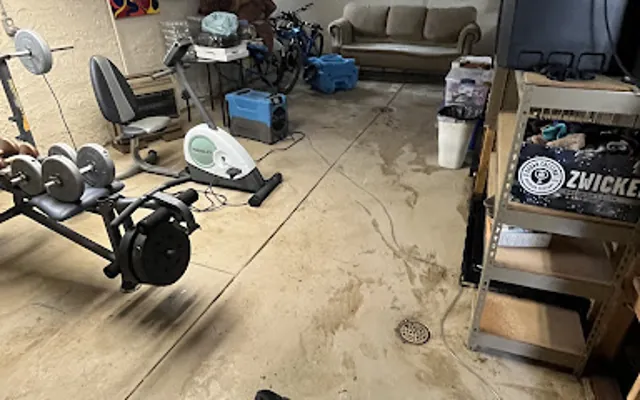
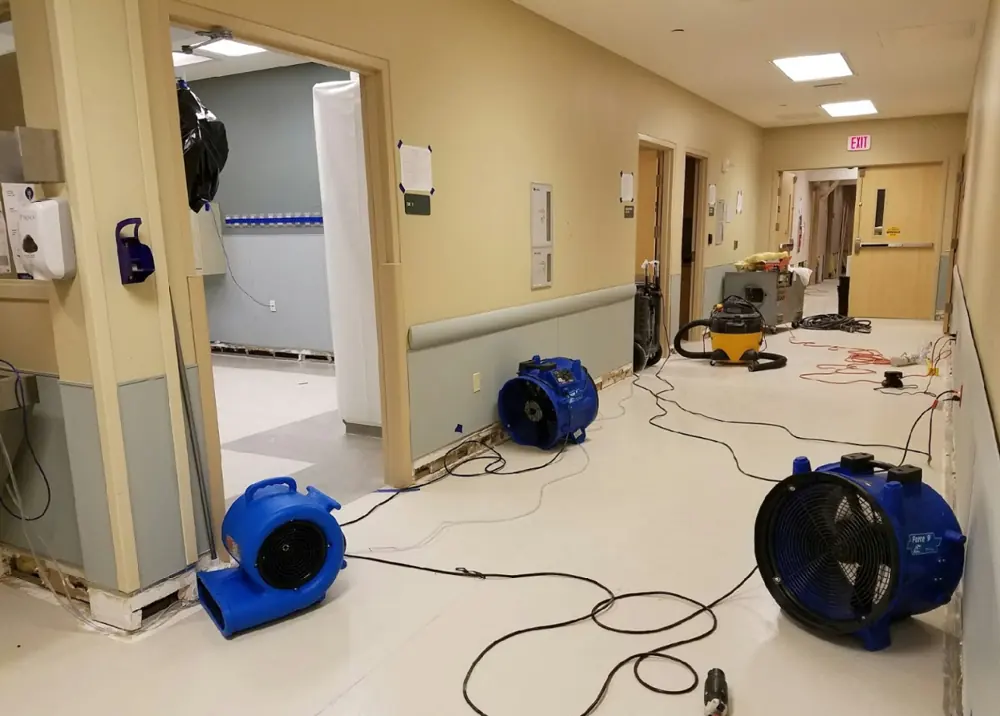
Slab leaks are less common in Boston, where basements are the rule, but slab-on-grade additions and mid-century homes do have pipes under concrete. When one fails, crews find the hidden moisture and dry the floors above it.

The crew uses moisture meters and mapping to pinpoint where water from the slab has reached the flooring and wall base, since the leak itself sits under concrete.
Standing or wicked water is extracted, and wet flooring and baseboard are removed where needed so the slab surface and wall base can be dried.
Air movers and dehumidifiers dry the slab surface, flooring, and wall base, with moisture readings tracked until the affected area reaches a verified target.
Access for a qualified plumbing contractor to repair the under-slab line is coordinated, and flooring and finishes are restored once the area reads dry.

While help is on the way, these first steps, done only where it is safe, limit the damage and protect the insurance claim.
Shut the supply off at the source, or close the home's main valve if the source is not obvious. Stopping the flow limits the damage more than anything else.
Switch off electricity to the affected area, but only if the breaker can be reached without standing in or touching the water.
Get a crew dispatched right away. The sooner extraction and drying begin, the more flooring, drywall, and belongings can be saved.
Take photos and a short video of the water and the affected rooms before anything is moved, so the insurance claim starts strong.
Slab leak water damage cleanup in Boston generally runs $2,000 to $7,500, depending on how long the line leaked under the floor, how much flooring absorbed the water, and how much must be removed to dry the slab. A quickly found leak sits near the low end, while a long-running one that damaged wide areas runs higher. The water damage is often covered even when the pipe repair is not, and the loss is documented.
Crews reach Boston and the surrounding metro fast, from Dorchester and East Boston to Cambridge, Somerville, Chelsea, Quincy, Brookline, and Newton. See the full list on the areas served across Boston page.
See all areas servedEvery loss is photographed, measured, and logged from the first visit, so the paperwork holds up with your insurance carrier.
Technicians follow recognized IICRC drying standards and prove the work with daily moisture readings, not guesswork.
Emergency dispatch any hour of the day or night, with a real crew on the way, not a callback in the morning.
A real crew dispatched any hour, not a callback in the morning.
Trained technicians following recognized IICRC drying standards.
Truck-mounted, portable, and submersible for any size loss.
The loss is documented and billed to the carrier directly.
Not especially. Most Boston homes sit over basements or fieldstone cellars rather than concrete slabs, so slab leaks are far less common here than in regions built slab-on-grade. They do occur in mid-century ranches, slab additions, and some newer construction where supply lines run under concrete.
Clues include a warm spot on the floor over a hot-water line, cupping hardwood or damp grout in one area, the sound of running water with everything off, an unexplained jump in the water bill, and a musty smell. Moisture mapping confirms where water from the slab reached the floor.
The resulting water damage to flooring and walls is often covered, even when the cost of accessing and repairing the pipe itself is excluded. Coverage varies by policy, so the crew documents the source, moisture readings, and photos so you can file with accurate records for your carrier.
Some flooring usually has to be removed to dry the slab and to give a plumbing contractor access to the line under it. The crew removes only what is needed, dries the slab to a verified target, and restores the flooring once the area and the repair are confirmed.
Boston crews are on call 24 hours a day, local and fast, and can be on the way within the hour.
Call (508) 593-9358