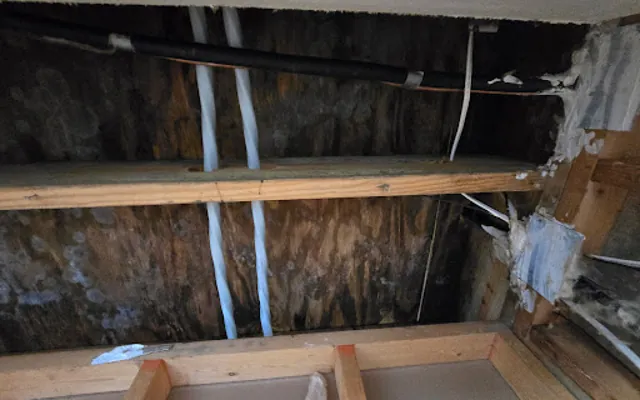
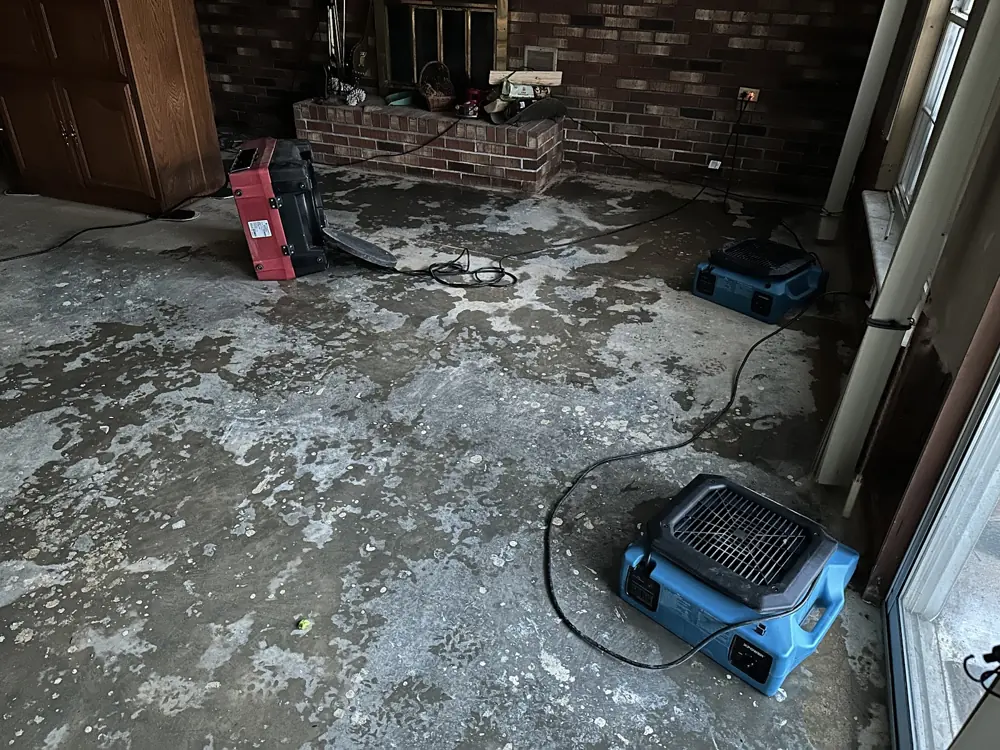
Ice dams are a classic New England winter problem, forming at the eaves after heavy snow and forcing meltwater up under the shingles. Crews dry the ceilings, walls, and attics the water soaks and stop the mold that follows.

The crew addresses the active leak, arranging to relieve the dam and cover the entry point so the roof stops taking on meltwater during the dry-out.
Standing water is extracted, and wet attic insulation, ceilings, and wall cavities are opened where needed to reach the water trapped inside the assemblies.
Air movers and dehumidifiers dry the sheathing, framing, wall cavities, and ceilings, with daily moisture readings tracking each affected area to a verified target.
Framing is treated against mold, and soaked insulation, drywall, and stained ceilings are restored once the structure reads verifiably dry throughout the top floor.

While help is on the way, these first steps, done only where it is safe, limit the damage and protect the insurance claim.
Shut the supply off at the source, or close the home's main valve if the source is not obvious. Stopping the flow limits the damage more than anything else.
Switch off electricity to the affected area, but only if the breaker can be reached without standing in or touching the water.
Get a crew dispatched right away. The sooner extraction and drying begin, the more flooring, drywall, and belongings can be saved.
Take photos and a short video of the water and the affected rooms before anything is moved, so the insurance claim starts strong.
Ice dam water damage cleanup in Boston generally runs $1,500 to $7,000, depending on how much meltwater got in, how many rooms and wall cavities it reached, and how much insulation, drywall, and ceiling must be removed and dried. A single stained ceiling caught early sits near the low end, while widespread intrusion across a top floor runs higher. Sudden ice-dam damage is usually a covered claim, and the loss is documented for the carrier.
Crews reach Boston and the surrounding metro fast, from Dorchester and East Boston to Cambridge, Somerville, Chelsea, Quincy, Brookline, and Newton. See the full list on the areas served across Boston page.
See all areas servedEvery loss is photographed, measured, and logged from the first visit, so the paperwork holds up with your insurance carrier.
Technicians follow recognized IICRC drying standards and prove the work with daily moisture readings, not guesswork.
Emergency dispatch any hour of the day or night, with a real crew on the way, not a callback in the morning.
A real crew dispatched any hour, not a callback in the morning.
Trained technicians following recognized IICRC drying standards.
Truck-mounted, portable, and submersible for any size loss.
The loss is documented and billed to the carrier directly.
Heat escaping into the attic melts snow on the upper roof, and that water refreezes when it reaches the cold eaves, forming a ridge of ice. Water pooling behind the ridge has nowhere to drain, so it backs up under the shingles and leaks into the attic, walls, and ceilings below.
Sudden interior water damage from an ice dam is usually a covered loss under a standard homeowners policy, though the cost of removing the ice itself may be handled separately. The crew documents the intrusion, moisture readings, and photos so the interior damage claim reflects what happened.
Often yes. A small visible stain usually means water is sitting in the attic insulation and wall cavity out of sight, where it feeds mold and keeps the framing wet. A moisture meter shows how far the water actually spread, and drying the hidden areas prevents a bigger problem later.
Better attic insulation and ventilation to keep the roof deck cold, sealing air leaks from the living space, and keeping gutters clear all reduce the risk. The crew notes where the water got in during the dry-out so the weak point in the roof and attic can be addressed.
Boston crews are on call 24 hours a day, local and fast, and can be on the way within the hour.
Call (508) 593-9358